

Storm Damage Cleanup
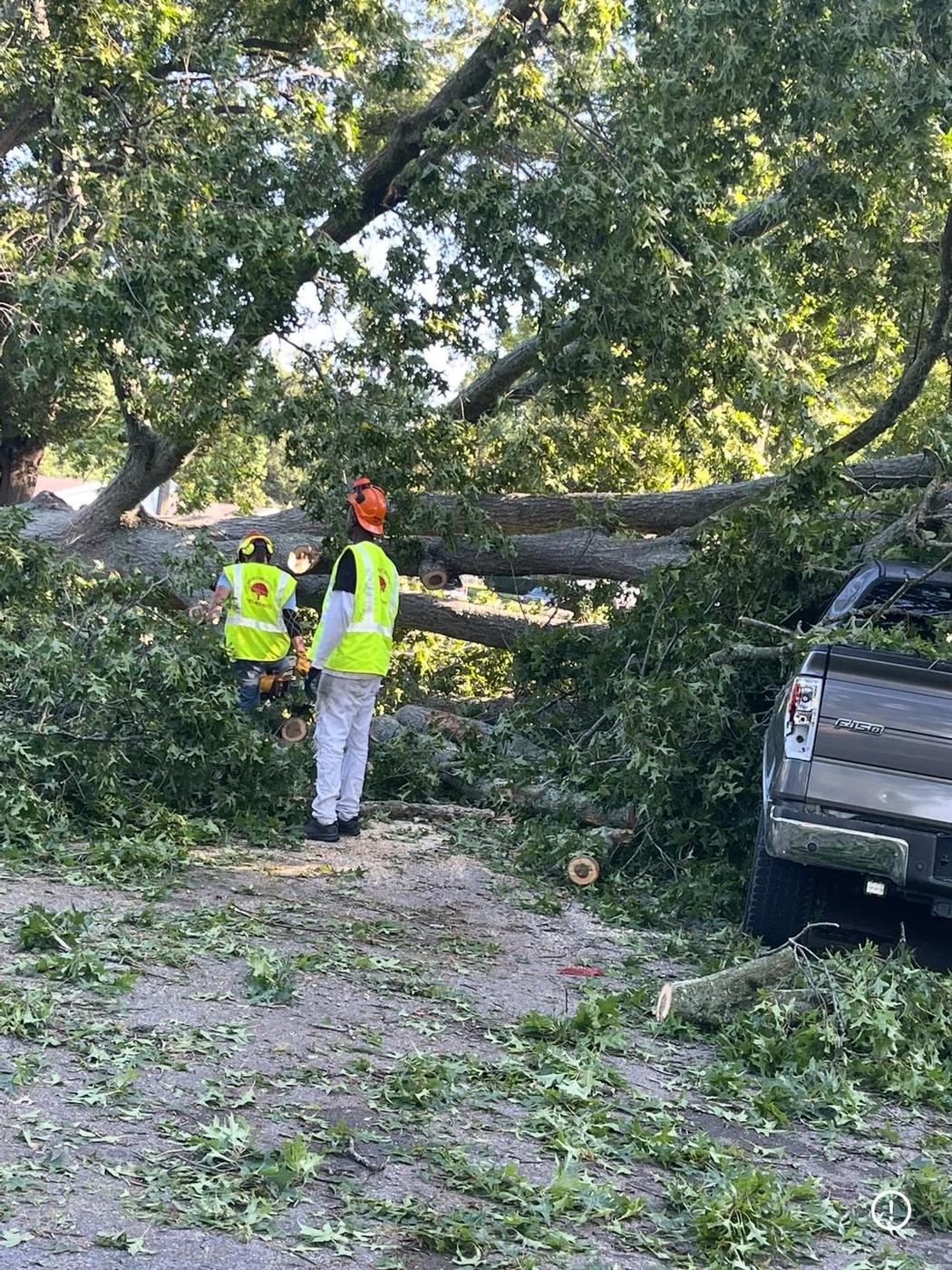
The Mid-South gets hit from every direction — derechos in summer, ice in January, and tornadoes in a season that now runs most of the year. We've been cleaning up after all of it since 2001.
Triage: what has to come down, and what can be saved
After a storm, the instinct is to remove everything that looks rough. Slow down. A tree that lost 20% of its canopy to wind is usually recoverable with cleanup pruning over the next two seasons. A tree that lost a co-dominant leader, tore bark down the trunk, or heaved its root plate is not.
What we look for, in order:
- Root plate movement. Cracked, mounded or lifted soil on the side opposite the lean. That tree is done — it just hasn't finished falling.
- Trunk cracks and bark tears running vertically. Structural.
- Percentage of crown lost. Past roughly half, recovery is a long shot on a mature tree.
- Hangers. Broken limbs still lodged in the canopy. These are the ones that hurt people days later, and they're the first thing we clear.
- Species. Bradford pear, silver maple and Siberian elm rarely come back from serious structural damage. Oaks and bald cypress often do.
Ice storms are a different animal
The Mid-South's ice events are the ones that break the region. Freezing rain can add hundreds of pounds of load to a canopy in a few hours, and the failure mode isn't a clean break — it's a whole crown coming apart at once, across an entire neighborhood, in the dark, with the power already out.
Ice work is slow, careful work: loaded limbs are under enormous stored energy and release violently when cut. It is not a homeowner-with-a-chainsaw job. If your trees are bent to the ground under ice, leave them alone — many will stand back up on their own once it melts.
Why storm season should start with a phone call, not a phone call
The cheapest storm work is the pruning you did in February. A pre-season risk assessment catches the split union, the dead leader and the decayed root flare while they're a $400 pruning job instead of a $9,000 insurance claim with a hole in your roof.
We'll walk your property, flag what's a problem and what isn't, and give you a written list in priority order. There's no charge and no obligation to do any of it.
What’s included
- Whole-property debris clearing, not just the one tree you called about
- Hangers and widow-makers pulled out of standing canopies
- Damaged-but-savable trees assessed before anything gets cut
- Roads, drives and access opened first
- Documentation package for your claim
- Multi-state surge response — we travel for major events
Tree down? Limb on the house? We roll 24/7 across the Mid-South.
Call (901) 461-6075 NowStorm Damage Cleanup — common questions
Does insurance cover storm tree removal?
Generally yes when the tree hit a covered structure, and often not when it fell in the open. See our insurance guide for how the coverage actually reads.
How soon can you get to me after a big storm?
Structure strikes and blocked access go first, then hazard trees, then general cleanup. Call early — the list fills fast after a regional event.
Do you travel out of the Memphis area for storms?
Yes. We respond across Tennessee, Mississippi, Arkansas, Kentucky, Missouri, Alabama and Georgia for major events.
My neighbor's tree fell on my property. Who pays?
In most cases your own policy handles damage to your property regardless of whose tree it was, unless the neighbor was demonstrably negligent — meaning the tree was a known hazard they were warned about and ignored. Document it, and read our guide.
You might also need
24/7 Emergency Service
Tree on the house at 2 a.m.? We answer.
Tree Risk Assessment
Find the problem before the storm does.
Tree Removal
Big, dangerous, or just in the way — it comes down clean.
Land & Lot Clearing
Building pads, fence lines, pastures, right-of-way.
Need storm damage cleanup? Let us get you a number.
Most quotes go out the same day you call. Storm and hazard work gets priority dispatch. Straight pricing, written estimate, and a yard that looks like we were never there.
(901) 461-6075